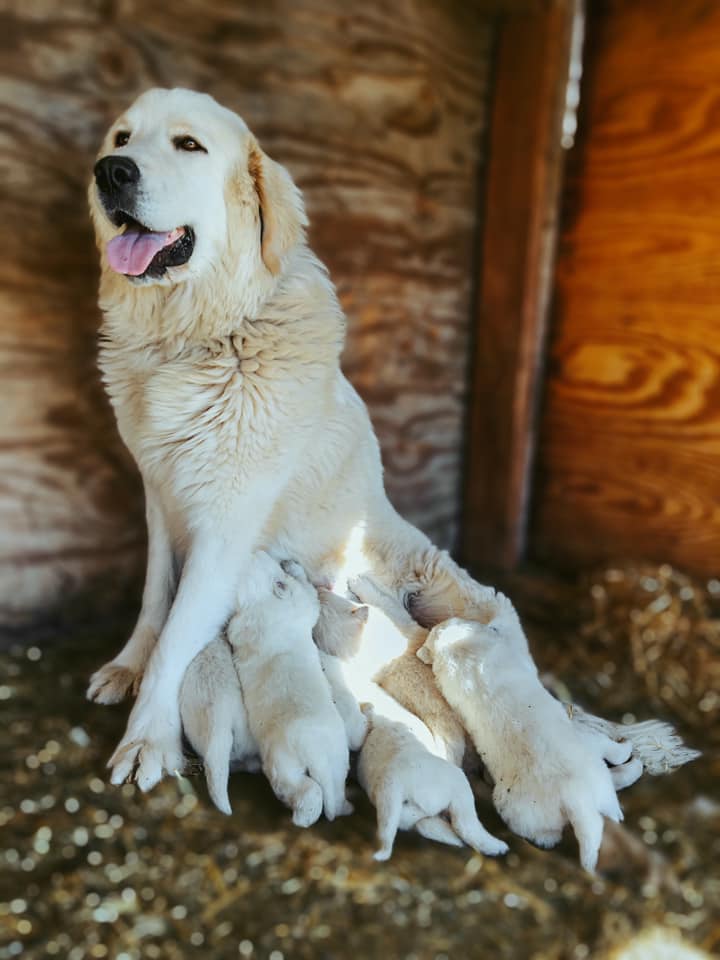

Whelping Process
Whelping: Labor, Delivery, and Complications (LGD-Focused)
Breeding and whelping rarely follow a perfect “textbook” timeline. The best outcomes come from preparation, close observation, and having a clear decision point for when to involve a veterinarian. This page summarizes practical, field-tested guidance for managing labor and recognizing complications early, especially relevant for livestock guardian dogs (LGDs), where weather, distance to veterinary care, and outdoor housing can add risk.
Before Labor Starts: Set Yourself Up for Success
Coordinate veterinary support in advance
- Confirm your primary clinic’s after-hours protocol and the nearest emergency hospital.
- Discuss what your veterinarian wants you to have on-hand and what constitutes an emergency in your situation (distance matters).
Prepare a clean, controlled whelping area
- For LGDs, the main risk is a dam choosing an isolated location (brush, under buildings, or out in a pasture). Plan for containment during the last 7–10 days (small pen/lot, predictable bedding, lighting). This reduces missed deliveries and exposure to hypothermia.
Track expected timing
- If you have an ovulation date (progesterone timing), you will be more accurate. If not, plan based on breeding dates and physical signs, and be conservative about when “overdue” becomes urgent.
Normal Stages of Labor (What to Expect)
Stage 1: Cervical dilation and “pre-labor”
Common signs:
- Restlessness, nesting, panting, discomfort, frequent urination/defecation attempts, reduced appetite.
- This stage often starts hours before delivery and can last up to 24–36 hours.
Field note: If your dam keeps trying to leave the whelping area, leash-walk for elimination and return her promptly. This prevents her from starting delivery in an unsafe location.
Stage 2: Active delivery (puppies are born)
- Visible abdominal contractions/straining, followed by puppy delivery.
- Some dams deliver steadily; others have a normal “rest phase” between puppies.
General time rules used by many veterinary and breeder resources
- If the dam rests more than 2 hours between puppies, contact your veterinarian (especially if you know there are more pups).
- Many references also flag 2–4 hours between puppies as a concern, depending on whether contractions have resumed and whether the dam is stable.
Stage 3: Placenta passage
- Placentas may pass shortly after each pup or occasionally later.
- Retained placentas can cause illness postpartum; keep a written count if possible.
“Call the Vet Now” Triggers (Practical Emergency Thresholds)
These thresholds are widely cited in veterinary guidance and are appropriate as a conservative decision tool:
Active labor not producing a puppy
- Strong contractions/straining for 20–30 minutes with no puppy delivered.
- Weak/infrequent contractions for 1–2 hours without progress.
Abnormal discharge
- Green/black discharge before a puppy is born, or green discharge with no puppy within 15–30 minutes (possible placental separation and fetal distress).
- Profuse bleeding at any point is urgent.
Too long overall
- Stage 1 signs lasting beyond ~24–36 hours without progressing to delivery warrant veterinary guidance.
- Active delivery (Stage 2) prolonged excessively (12–24 hours) is a major red flag.
Spacing between puppies
- More than 2–4 hours between puppies (especially if you know more remain) is a concern; call your veterinarian.
Maternal distress
- Extreme pain, collapse, persistent vomiting, marked weakness, or signs of shock are emergencies.
What Dystocia Is and Why It Happens
Dystocia means difficult or prolonged labor. It commonly falls into two categories:
1) Obstructive dystocia (a puppy can’t pass)
Common contributors:
- Oversized pup, malpresentation (breech can be normal, but some positions are problematic), narrow pelvis, or uterine torsion (rare but serious).
2) Functional dystocia (uterine inertia)
- The uterus fails to contract effectively (primary inertia) or becomes exhausted after some puppies are delivered (secondary inertia).
- Can be associated with fatigue, dehydration, electrolyte imbalance, or very small/very large litter size patterns.
Veterinary sources emphasize using the stage of labor, along with the above thresholds, to determine when intervention is required.
On-the-Ground Management During Whelping
What to monitor (write it down)
Create a simple “whelping log”:
- Time Stage 1 signs began
- Temperature trends (if you monitor)
- Time each pup is born
- Sex/color/markings (for ID)
- Placenta passed (yes/no)
- Any concerns (weak pup, prolonged interval, discharge)
Normal vs. not normal rest periods
It is normal for a dam to rest between puppies. The question is whether:
- She is comfortable, responsive, and stable, and
- The rest period does not exceed the time thresholds above.
AKC guidance commonly used by breeders is to contact the veterinarian if a break exceeds two hours.
Immediate Post-Delivery Checks (First Hour Matters)
For each puppy:
- Confirm breathing, clear fluid from nose/mouth if needed.
- Ensure the pup warms and nurses.
- Watch for continuous crying, poor nursing, or being pushed away; these are early danger signs.
For the dam:
- Normal maternal behavior includes licking, stimulating, and settling.
- If she is inattentive, distressed, febrile, or has a foul discharge, contact your veterinarian.
Common Complications After Whelping (Dam and Puppies)
Dam
- Retained placenta/metritis (often fever, lethargy, foul discharge)
- Mastitis (hot/painful mammary glands, dam may refuse nursing)
- Eclampsia/hypocalcemia (restlessness, tremors, panting; can progress rapidly, urgent)
- Postpartum hemorrhage
Puppies
- Hypothermia (quiet, weak, cool to the touch)
- Failure to nurse / low energy
- Congenital issues (cleft palate, etc.)
When puppies show poor nursing or abnormal posture/behavior early, veterinary consultation is recommended because intervention can be time-sensitive.
LGD-Specific Risk Management
Because many LGDs live outdoors or have limited supervision:
- Do not rely on “she’ll figure it out” as a plan. Even excellent dams can select unsafe locations.
- Use a controlled pen/lot in the final week to reduce:
- pups born into cold/rain,
- predation risk,
- delayed discovery of dystocia,
- mismothering due to disturbance.
If you must whelp in a barn or pasture-adjacent setting, prioritize dry bedding, draft protection, and nighttime checks.
Quick Reference: When to Escalate
Contact a veterinarian urgently if any of the following occur:
- Strong straining >20–30 minutes with no puppy
- Weak contractions >1–2 hours without progress
- Green/black discharge with no puppy within 15–30 minutes
- >2–4 hours between puppies when more are expected
- Heavy bleeding, collapse, or severe distress
Site Disclaimer
This page is provided for educational purposes only and does not replace a veterinarian-client-patient relationship. Whelping complications can become life-threatening quickly for the dam and puppies. If you are concerned about labor progression, discharge, maternal condition, or puppy viability, contact a licensed veterinarian or emergency clinic immediately.