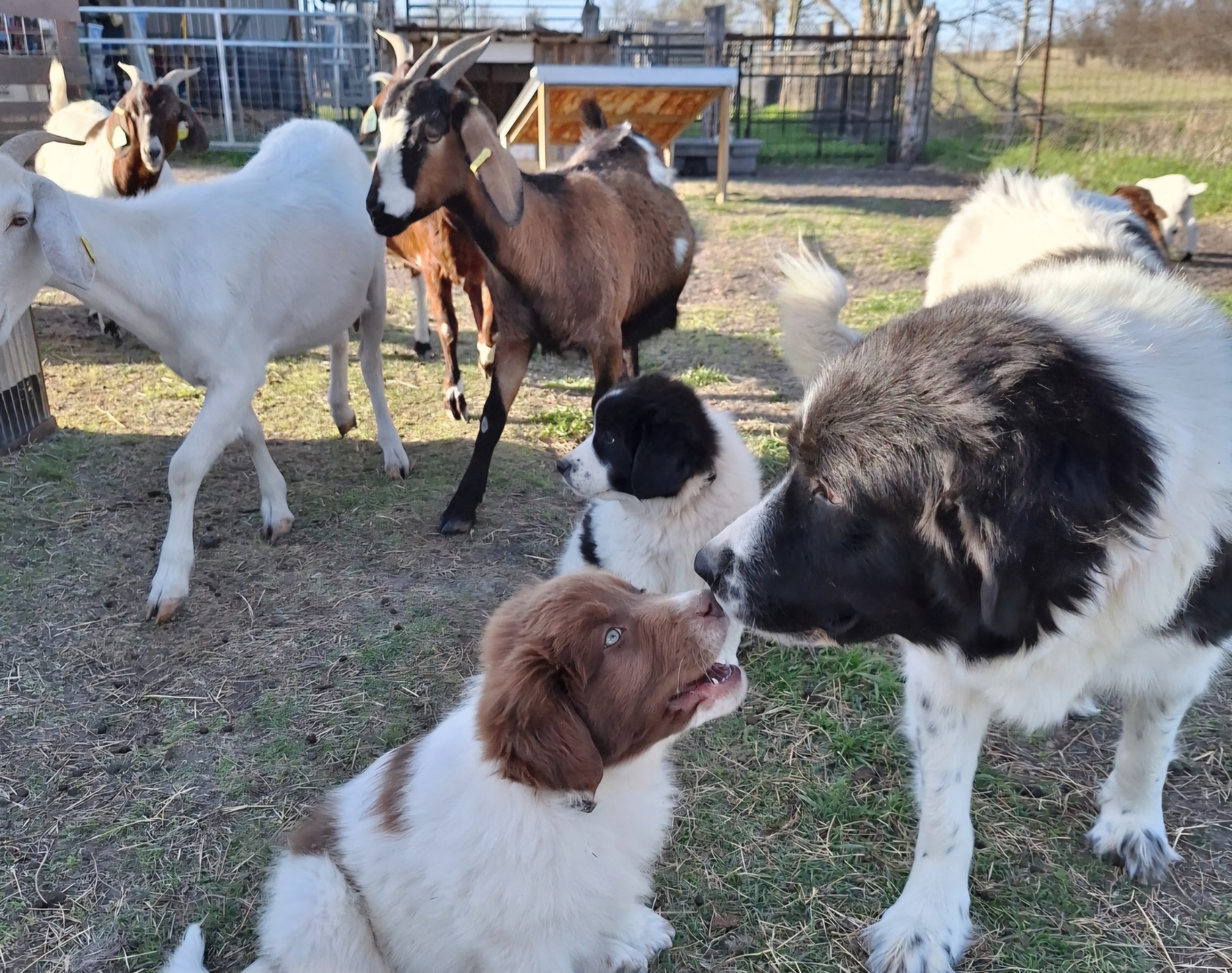

Puppy Socialization
Puppy Socialization for Livestock Guardian Dogs
Key developmental windows, risk management, and practical steps for breeders and new owners
Early socialization is one of the most reliable, evidence-based ways to improve long-term behavior and reduce fear, reactivity, and avoidable rehoming. In puppies, the “primary window” for learning that new people, animals, and environments are safe occurs early, generally within the first three months, when sociability tends to outweigh fear.
For working LGDs, socialization has a dual purpose:
- Create a dog that is safe and manageable around people, handling, and routine husbandry, and
- Protect and strengthen the dog’s bond to livestock and its working role.
Core Principles (What Research and Veterinary Guidance Agree On)
1) Genetics matter, but environment shapes outcomes
Temperament is influenced by both heredity and experience. Strong socialization cannot “fix” severe genetic temperament deficits, but poor socialization can undermine otherwise solid working potential.
2) Timing matters: the critical period is early
Many veterinary and professional references place the most sensitive period of social development between 3 and 14 weeks of age. This is similar to the bonding/imprinting time in puppies. This does not mean socialization stops later; it means early exposures are disproportionately influential.
3) “Safe socialization before full vaccination” is standard guidance
Behavior professionals explicitly caution that delaying all exposure until vaccination completion can increase behavior risk. The recommended approach is controlled, low-risk exposure (known dogs, clean environments, thoughtful biosecurity) rather than isolation.
What This Means for LGDs
LGDs must be:
- Socially stable (tolerant of normal human activity, veterinarians, farriers, delivery drivers, neighbors)
- Operationally manageable (catchable, halter/lead tolerant when needed, cooperative for basic care)
- Correctly bonded (oriented to livestock, not roaming for entertainment, not over-attached to people)
A practical rule: Socialize broadly, but do it in a way that keeps livestock contact primary.
Developmental Timeline and Practical Protocols (0–16 Weeks)
0–2 weeks: Neonatal period (handling and calm exposure)
Goals: gentle habituation, health monitoring, low-stress handling.
Best practices:
- Short, calm handling sessions paired with warmth and return to the dam.
- Maintain stable temperature and hygiene; avoid overstimulation.
- Keep stress low for the dam; maternal stress late in pregnancy and early postpartum can affect puppy behavior and coping.
Evidence note: Gentle early handling “early neurological stimulation” has mixed findings across studies, but controlled early handling is widely used in working-dog programs; recent work evaluates welfare and developmental effects without claiming it is a magic solution.
2–4 weeks: Transitional period (senses “turn on”)
Goals: begin low-intensity exposure to normal life.
Best practices:
- Soft sound exposure (barn sounds, vehicles at a distance, gates, water trough noise).
- Brief human contact with multiple calm people (varied ages/appearances), always returning pups to a secure resting area.
- Keep surfaces clean and dry; avoid high-traffic public areas.
3–6 weeks: Primary socialization to dogs and environment
Goals: puppy learns canine communication through dam/littermates; begin safe novelty.
Best practices:
- Preserve litter time; avoid early weaning. Veterinary guidance and behavior literature emphasize the value of appropriate dog-to-dog interaction during this phase. (UC Davis School of Veterinary Medicine)
- Introduce controlled novelty: different footing (straw, rubber mat, dirt), low steps, small obstacles, stable livestock sounds and smells.
- For LGDs: introduce stock presence in a controlled way (adjacent pen exposure, calm stock, supervised).
5–8 weeks: Human socialization window (important for working LGDs)
Goals: create a pup that is approachable and safe to handle without creating an exclusively “pet-bonded” dog.
Best practices:
- Short, positive interactions with different people (hats, coats, gloves, headlamps).
- Brief handling routines: checking feet, mouth, ears; calm restraint; collar introduction.
- Pair people with neutral/positive outcomes (food, calm touch), then return the pup to the livestock context.
Important caution: For LGDs, “constant cuddling” and house-only time can shift preferences away from livestock. The target is calm acceptance of humans, not human dependence.
8–10 weeks: High sensitivity/fear imprint risk-management
Many sources note that puppies can be especially sensitive to frightening experiences during early fear periods; one bad event can have an outsized impact.
Best practices:
- Avoid forced exposures (chasing, rough restraint, chaotic dog parks, loud uncontrolled environments).
- Keep exposures short, controlled, and escapable (puppy can retreat and recover).
- If something spooks a pup, reduce intensity and rebuild confidence gradually.
8–16 weeks: Secondary socialization (handoff to new owner)
Goals: maintain progress; teach routine management behaviors.
Best practices:
- Continue structured novelty: ATVs/UTVs at distance, feeding routines, gates, panels, hauling prep (crate/vehicle).
- Controlled dog-dog introductions only with known stable dogs.
- Start early boundary training (fence respect, supervised pasture transitions).
- Begin “life skills” that prevent rehoming: recall-to-handler in a small pen, wearing a drag line, calm tethering, and grooming tolerance.
LGD-Specific Socialization Targets (What to Include)
People and handling (minimum working standard)
- Accept being caught, collared, and led (even if the dog primarily works independently)
- Calm for basic checks: feet, ears, mouth
- Tolerant of routine ranch traffic and visitors
Why it matters: Many LGDs are rehomed not for “lack of guarding,” but because they are difficult to handle safely.
Livestock and infrastructure (prevent common failure points)
- Calm proximity to livestock without chasing/rough play
- Exposure to handling systems: alleys, chutes, sorting, feed bunks
- Fence and boundary basics (do not delay this for “later”)
Sounds, surfaces, and novelty (build resilience)
- Metal gates, panels, water troughs
- Vehicles, trailers (at a safe distance initially)
- Weather events: wind, rain, thunder routines (calm management, not dramatic soothing)
Biosecurity: Socialize Safely (Not “All or Nothing”)
Behavior and veterinary organizations emphasize the risk tradeoff: infectious disease matters, but so do lifelong behavior outcomes. The best approach is controlled exposure:
- Known healthy dogs (vaccinated, stable temperament)
- Clean locations (private yards, controlled facilities)
- Avoid unknown high-traffic dog areas during peak vulnerability
This aligns with professional guidance supporting early socialization before completion of the full vaccine series when done responsibly.
Common Socialization Failure Points (and How They Show Up Later)
- Too little novelty early → fearfulness, reactivity, avoidance behaviors
- Too much uncontrolled novelty → sensitization, stress, defensive behavior
- Human-only upbringing for LGDs → weak livestock bond, roaming, poor placement fit
- No boundary training → chronic roaming, neighbor conflict, liability risk
- Early separation from litter → poor dog-dog social skills, bite inhibition issues (varies by situation)
Quick Checklist: “Good LGD Socialization” Should Produce a Pup That…
- Recovers quickly from startle (not shut down for long periods)
- Can be caught and handled without escalation
- Shows interest in livestock without predatory play
- Accepts normal ranch routines (vehicles, gates, feeding)
- Demonstrates steady progress week-to-week (not just “good days”)
Practical Note for Breeders: What to Send Home
Send new owners home with:
- A simple 2–3 week “transition plan” (routine, boundaries, supervision)
- A short list of “do first” priorities (containment, livestock exposure plan, vet handling plan)
- Clear guidance on what is normal at 8–16 weeks vs. what needs intervention